Wildlife wonders
A living river: Helford wildlife revealed by Cornwall Wildlife Trust experts
Wildlife wonders
The Helford River is one of Cornwall’s most stunning landscapes, where green fields and woodlands merge with the clear waters of the sea. Designated as one of the county’s voluntary Marine Conservation Areas, the Helford estuary boasts a shoreline of more than 47 km. Cornwall Wildlife Trust carries out a range of activities across the area to help protect and enhance the rich and varied wildlife of this internationally important site. From surveying to campaigning, we work hard to keep this precious area wild.
Wild waters
Whether your interest lies in snorkelling or diving, the Helford offers opportunities for a stunning experience. Under the surface of the river lies a complex web of rare and precious habitats, including beds of seagrass and rare areas of living maerl.
If you walk down to Grebe beach or any other cove between Durgan and Toll Point on the north shore of the Helford River at very low tide, you might glimpse the green strands of eelgrass swaying in the water just offshore. This very special habitat provides shelter from strong currents and predators for many sea creatures, including fish, cuttlefish, and sea hares.
Cornwall Wildlife Trust is trialling techniques to restore seagrass in areas of the Helford where it has previously been lost. We hope that this pioneering project could lead the way for large-scale seagrass restoration across Cornwall.
Maerl beds are intricate habitats created on shallow seabeds by a very special group of red algae species. These unique seaweeds grow as twiglet-shaped hard nodules called rhodoliths - literally meaning "red stones." Just like all plants, they grow using sunlight and photosynthesis, but they also extract minerals from the water around them as they grow, thus building up a hard, coral-like structure.
Maerl beds are teeming with life, and the millions of tiny gaps between the nodules are perfect for juvenile crustaceans, worms, molluscs, and anemones to live. Cornwall Wildlife Trust carries out regular surveys to monitor and protect this fragile habitat.
Wild edges
The rocky shores of the Helford Estuary are any rockpooler’s dream. When the tide is out, you can discover a huge diversity of animals and plants in and among the rockpools and muddy sandflats.
Cornwall Wildlife Trust’s Shore search project team carries out a survey every year at Prisk Cove, where the diversity of discoveries never disappoints. From spiny starfish to hermit crabs, this hidden gem offers a fascinating wildlife experience.
Wild skies
Two of the Helford’s most noticeable birds are the resident members of the heron family: the grey heron and the little egret. Almost the size of a golden eagle, the grey heron is the most widespread large predatory bird in the UK.
Herons are often seen standing as still as statues on their long, thin legs in the shallow waters of ponds and lakes, patiently waiting for their next meal to swim by. Make sure you look out for these incredible birds in flight - their slow-flapping wings and long legs held out behind make them hard to miss.
The grey heron is an easily recognised, grey-backed bird with long legs, a long white neck, a bright yellow bill, and a black eyestripe that continues as drooping feathers down the neck.
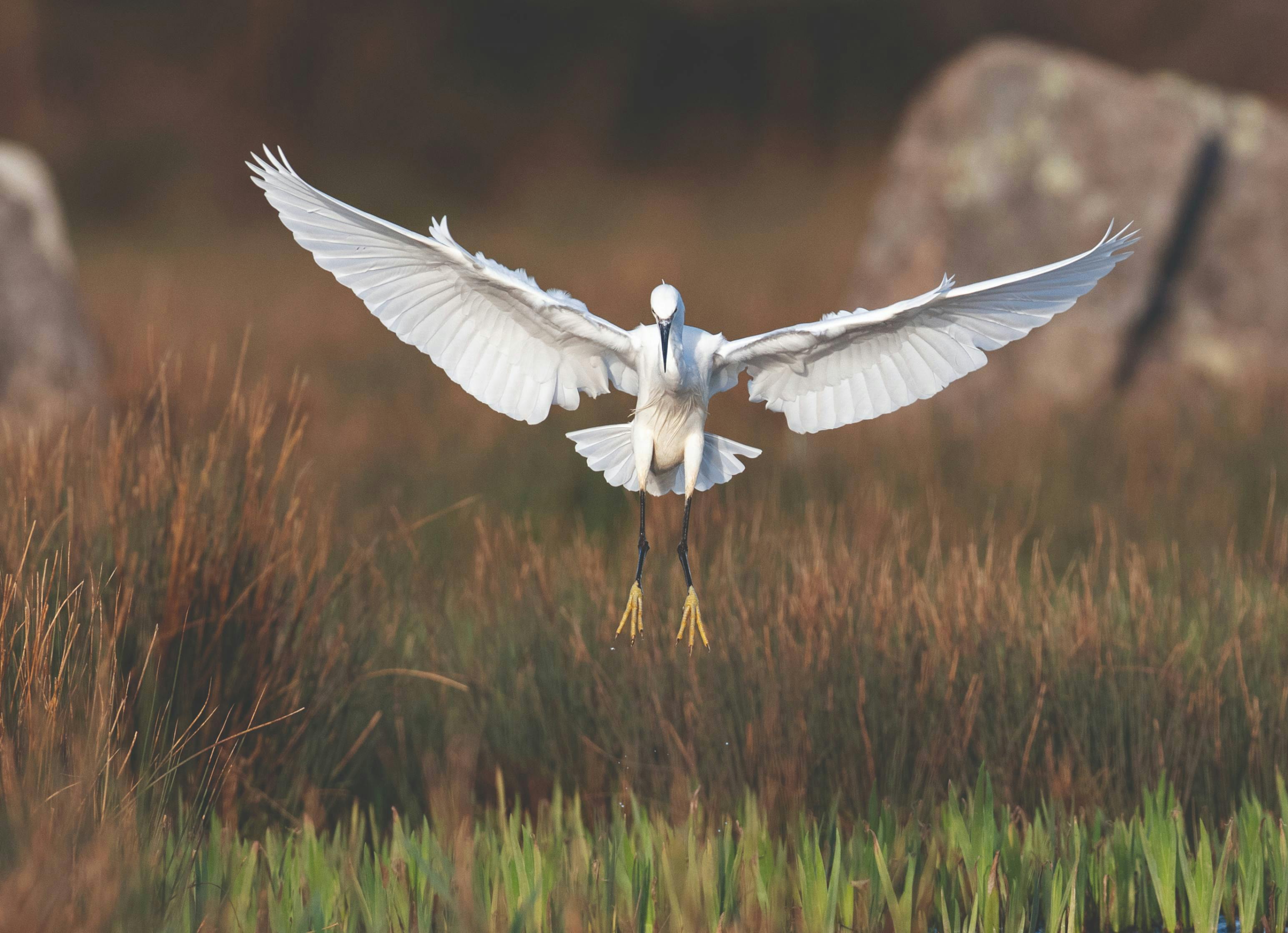
The little egret is a white heron with black legs and yellow feet. This elegant bird has a black bill and long plumes on its head and neck during the breeding season. Please support our work by reporting your wild Helford sightings on our website.
Help keep the Helford wild
Seagrass and maerl beds are particularly sensitive to abrasion. When visiting the Helford by boat, it is best practice to use a visitor mooring. If you need to anchor, do so at least200 metres from shore and in 7 metres of depth, outside the ‘no anchor zone’, and not above oyster beds.
To avoid disturbing wildlife, use binoculars, keep your distance, and do not approach or follow. When rockpooling, snorkelling, or diving, leave no trace - and take only photographs and memories home with you.
You can support our work to protect the Helford and other marine areas across Cornwall by donating to the Ocean Emergency Fund. Details can be found at cornwallwildlifetrust.org.uk
Photo credit: Little Egret, Adrian Langdon